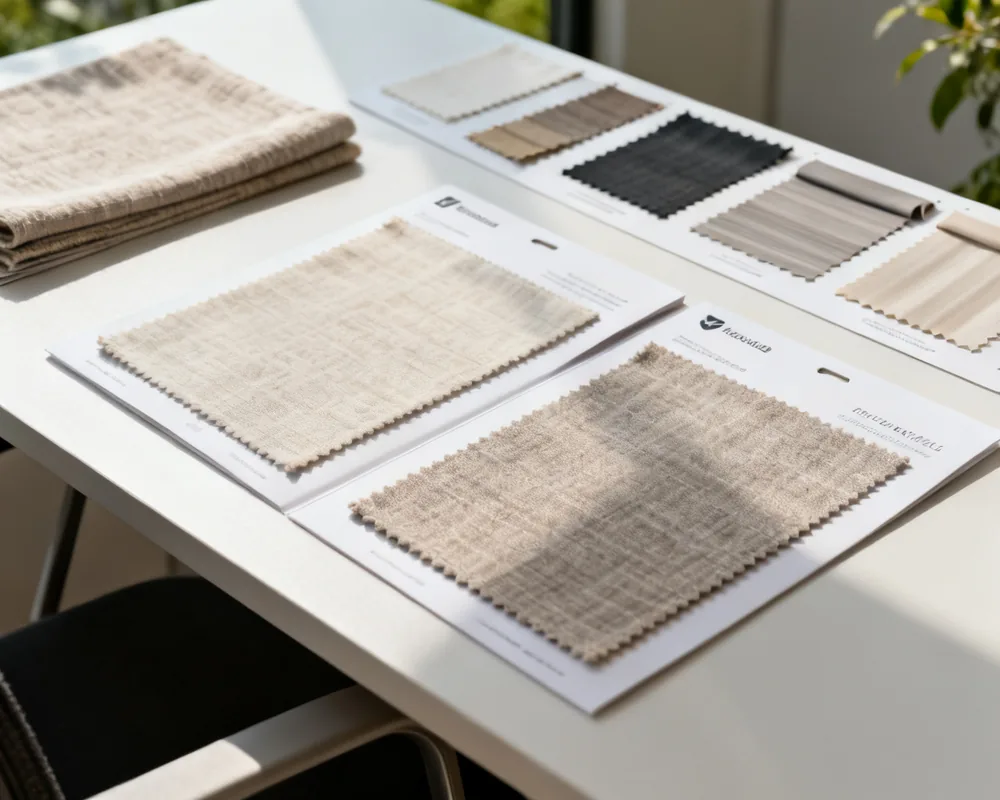
Handle the sample as information
Use the cutting as a record, not as a souvenir. Fold it the way the cushion or the seat pad will fold. Look at the face under the light of the room, then under daylight if the cloth will go outside. Note thickness, drape and whether the back looks different from the face. Write the construction you think you are holding and the finish you were told is present. If the comparison is between two outdoor cloths, say whether you are judging softness, water on the surface, or the way a hem will turn. That keeps the sample from answering a vague impression.
Compare the construction, not one label
A fibre name and a GSM describe useful parts of indoor upholstery or outdoor performance cloth, and they leave the weave, the yarn and the finish still open. Two cloths with a close mass can differ in seam behavior and in how the surface looks after rubbing. When a property is central, ask for a method that matches it: abrasion or pilling for seating contact, a stated water method for rain on a shade cloth, colorfastness for a cushion that stays in the sun. Keep the specimen condition in the same note. A result on a new finish is not a result on a washed or weathered cutting. Do not collapse water resistance and vapour movement into one line. Hydrostatic head, if someone quotes it, is a liquid-water reading. Water-vapour transmission is a different method and a different unit.
Prepare a shortlist with tradeoffs
More than one Sunbrella fabric route can be plausible. An indoor seat may prize hand and still need a width that fits the pattern. An awning may prize a stable edge and accept a firmer face. A marine cover may need folding and sun notes that a decorative cushion never sees. Write the priority you will not give up, the priority you can flex, and the uncertainty the next cutting should settle. That tradeoff is more useful than treating one cloth as universal. Availability, a minimum quantity and a delivery date stay outside this guide until they are confirmed against a named reference and a destination.
Hold both sides of the material choice
Natural-fibre arguments start with touch, moisture take-up and how the cloth sits in a room. Synthetic-fibre arguments start with strength, drying and the finishes that can be applied. Neither side is an environmental ranking, and this site does not award one. A dining seat can follow the natural-fibre conversation and still need a synthetic yarn where arm rub is the open question. An outdoor cushion can follow the synthetic-fibre conversation and still be set aside if the hand is too stiff for that furniture.
A coated substrate is reviewed by coating add-on, adhesion and how soft the cloth stays after the coating. A laminated construction is reviewed by the film, peel resistance and the specimen state, including whether the membrane is still attached at the edge you will sew. If you cannot tell which construction you are holding, record that uncertainty. Do not copy a waterproof sentence from a brochure onto both.
Stock selection asks which lot is actually available, how the shade band was set, and whether a repeat cutting is continuous. Custom development keeps the change at sample, test and bulk-approval points, and any minimum or development interval stays a question. This page cannot publish either number. Air permeability, stretch recovery and tensile strength are separate lines from those commercial questions, and each one needs its own method before a figure is compared.
A buyer target is not a Sunbrella specification. One seating request might ask for a mass near 320 g/m², a cuttable width near 140 cm, and a declared fibre composition that adds to 100% by mass. If yarn linear density comes up, keep it in denier or dtex and do not rewrite it as a cotton count. Warp and weft, or the knit structure, still need their own note. The cutting confirms or corrects those figures. They are not measured results for a named quality, and they do not imply a certificate, a plant output, a founding year or a delivery date. Those company facts are not on file.